Sunday, September 18, 2011

Jewelry
Jewelry of gold and silver reflects the preferences of ethnic groups. Gurung women often wear large disc earrings of bronze and copper, while Sherpa women often have turquoise and silver earrings. Other forms of jewelry include nose rings, pendants, engraved silver belts, anklets and bracelets


Pottery 

Pottery flourishes in Patan and Thimi, a locality near Bhaktapur. Common forms of pottery are terra cotta oil lamps used to light homes during the festival Dipawali, and flower pots decorated with peacocks and elephants.
Literature

Literature appeared in the valley during the 18th century. Poetry is the predominant form of writing from this period, but most authors are unknown. The following centuries brought more poets and writers inspired by religion as well as social problems. Musical lyrics celebrate the beauty of nature and life, or convey a legend.


Bronze figures
 
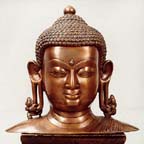
Bronze figures, sometimes alloyed with copper, appeared in the valley around 8th century AD. These images usually represented religious deities or legendary figures. The most frequently used production technique is that of cire perdue, a form of wax casting. Images often contain embedded semi-precious stones, usually coral or turquoise, or are gilded with gold.
 Painting

The earliest paintings appeared in 11th century AD. and consisted of illustrated manuscripts on palm leaf or rice paper. Thangkas, a more predominant form of painting, are popular among Buddhists in Nepal as well as in Tibet and date back to the late 14th century. These paintings on cotton are rectangular in shape and usually longer than they are wide.
 They are framed with three stripes of Chinese brocade of blue, yellow and red which represent the rainbow which separates sacred objects from the material world. Older Thangkas consisted of mineral-based colors, while current Thangkas are produced with vegetable-based or chemical colors. Frequent themes of Thangkas include images of Buddhist figures, mandala designs, the wheel of life design, or depiction of scenes or stories.
Architecture

People walking the streets of Kathmandu cannot fail to notice the abundance of religious buildings in the city. Temples exist near or around royal palaces, as well as at important geographical locations including the top of hills, river banks or near wells. Private temples were built anywhere and can be found in almost every neighbourhood.
The temples are sites of magnificent stone and wood carvings. Most of the stone carvings are from the eleventh and twelfth centuries and reflect the influence of Indian art from the Gupta (5 and 6th century A.D.) and the Palasena (10th to 12th century AD.) periods. Wood carvings are predominantly from the eighteenth century used to decorate pillars, door and window frames, cornices and supporting struts. Struts of Hindu temples usually contain an erotic scene which attracts speculation from visitors. The motivation for such motifs are natural; in countries where death is predominant, procreation is sacred in some respects as the embodiment of life-giving energies and fertility. Sexual union also represents the union of the individual with the universe in the Vedas which are Hindu texts.
Sangha

 Sangha  is community of Buddhists. Used to mean monastic community but concept broadened. Showing the path to enlightenment.
About 100 years after Buddha's death, communities disagreed and split over ways to achieve enlightenment. Traditional school of Theravada Buddhists follows Buddha's original teachings. Mahayana school accepts some changes, various ways to enlightenment (became Zen).
Scripts appeared also introducing changes. Deification of Buddha, and separation between mortal Buddha like Siddharta who will reappear, and transcendental ones which are only understood through meditation (Dhyani Buddhas). While enlightenment reached through individual effort, idea spread that meditation Buddhas give merit to those who worship them. Bodhisattvas are humans who reached enlightenment but instead of joining nirvana chose to help others reach enlightenment.
Buddhism

Based on meditations of Siddhartha Gautam, also called Sakyamuni (wise man of the Sakya clan) and later the Buddha (Enlightened one). Philosophical doctrine and code of conduct. Based on the three jewels, Buddha himself, dharma, Buddha's teachings and prescribed conduct, and sangha the community.
Buddha was born in Lumbini, Nepal around 544 BC. Son of raja (title for rulers and wealthy landlords) who sought reason for human misery. Left his family and experimented and traveled; found enlightenment through meditation at Bodh Gaya.
Brahma 

 Brahma is the creator of the universe. Attributes are the rosary, the receptacle of holy water, the ladle and the book. Mount is a goose or swan. Brahma usually represented with four heads, allows him to watch over world. Very few statues of Brahma since creation is done.
Saraswati 

Saraswati is Brahma's consort and is goddess of knowledge, learning and music. She is often portrayed with four arms, plying the veena (seven stringed musical instrument) with two hands as well as holding a rosary and a book. Sits on a lotus riding a peacock or a swan. Often a crescent moon on forehead. Worshipped by Buddhists as a form of Manjushri, the Bodhisattva of wisdom.